
How to Clean Shower Grout (and Stop Mold from Coming Back)
Updated: Jun 26
Dingy Grout Isn't Your Fault, Here's How to Fix It
Of all the grout in your house, the grout in your shower has the hardest job. It spends part of every day soaking wet, it rarely gets a chance to fully dry, and it lives in a warm room. That combination is a perfect storm for discoloration, mildew, and the black, fuzzy-looking grout that shows up no matter how often you wipe the tile down.
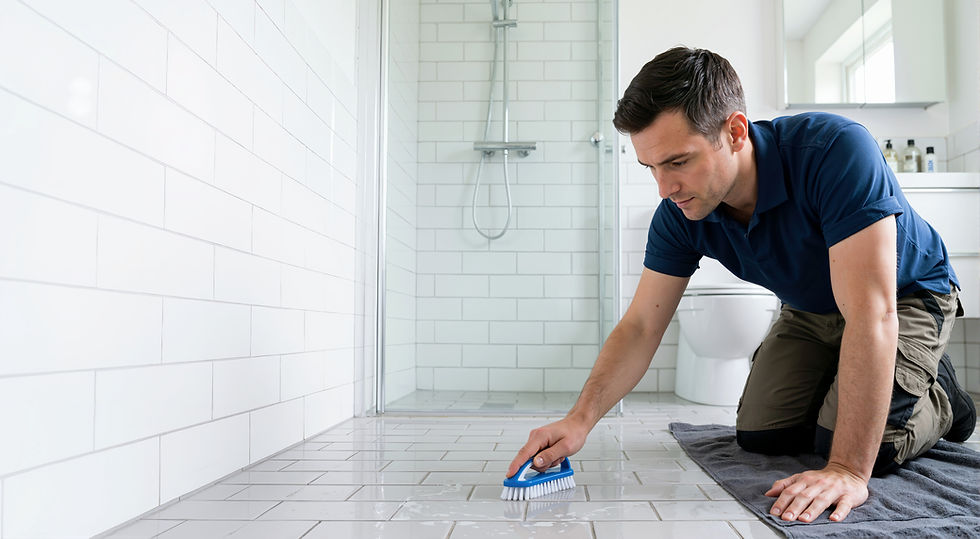
The good news is that most shower grout can be brought back to life with the right approach, and more importantly, you can keep it clean once you get there. Here's how to clean shower grout properly, how to deal with mold when it shows up, and how to stop the whole cycle from starting over again.
Why shower grout turns black and moldy
Grout is porous. Under a microscope it looks less like a solid surface and more like a sponge full of tiny channels, and those channels happily soak up water, soap scum, and anything else that lands on them. In a shower, what they soak up most is moisture, and moisture that never fully dries out is exactly what mold and mildew need to take hold.
There are usually three things working against your shower grout at once:
Constant moisture. Grout that stays damp between showers gives mold a place to grow.
Soap scum and body oils. These build up in a thin film that traps dirt and feeds mildew.
Hard water. Here in Utah County, our water is loaded with minerals. As it dries on your tile and grout, it leaves a chalky film that dulls the surface and gives grime even more to cling to.
So when your shower grout looks dingy or black, it usually isn't one stain. It's layers: minerals, soap film, and mildew all built up together. That's why a quick scrub with whatever's under the sink rarely does the trick.
What you'll need
Oxygen bleach (a gentler, color-safe alternative to chlorine bleach), or hydrogen peroxide
Baking soda
A stiff-bristled grout brush or an old toothbrush
A spray bottle
Rubber gloves and good ventilation
A quick word of caution before you start: if your shower is natural stone such as marble, travertine, or slate, skip the vinegar and any acidic cleaners. Acid etches stone permanently. Use a pH-neutral stone-safe cleaner instead. For standard ceramic or porcelain tile, the methods below are safe.
How to clean shower grout step by step
Rinse the walls with warm water to loosen surface soap scum.
Mix oxygen bleach with warm water into a thin paste, or make a paste of baking soda and hydrogen peroxide for tougher spots.
Apply it directly to the grout lines and let it dwell for 10 to 15 minutes. The dwell time is doing the real work here, so don't rush it.
Scrub along the grout lines with your brush, working in short strokes that follow the line rather than crossing it.
Rinse thoroughly with clean water so no cleaning film is left behind. Leftover residue actually attracts more grime.
Dry the area with a towel and leave the fan running or a window open so the grout finishes drying out.
For the same approach on a larger scale, the tile itself can be cleaned with the same solution. To clean shower tile without dulling it, avoid abrasive pads on glossy surfaces and stick to a soft cloth or sponge after the grout work is done.
How to remove black mold from shower grout
Black mold in shower grout is its own challenge, because there's a difference between mold sitting on the surface and mold that has grown down into the grout or the caulk.
Surface mold usually responds well to the oxygen bleach method above. Let the solution sit a little longer, around 15 minutes, then scrub and rinse. Repeat if needed.
Mold that keeps coming back in the same spot, even after a thorough clean, is a sign it has worked its way deeper than the surface. At that point you're not really cleaning anymore, you're fighting the grout itself. If the discoloration is in the soft caulk at the corners and seams rather than the hard grout lines, that caulk often needs to be cut out and replaced. If it's deep in the grout lines, the grout may need professional restoration or, in stubborn cases, regrouting.
One important safety note: resist the urge to mix cleaning products to make them "stronger." Combining bleach with other cleaners can create dangerous fumes. Stick to one method, ventilate the room, and give it time to work.
The real secret: keeping it clean
Cleaning shower grout is satisfying, but doing it every few weeks forever is not. The single biggest factor in how fast mold returns is how quickly your shower dries out after you use it. Manage the moisture and you starve the mold.
A few habits that make a genuine difference:
Squeegee the walls after each shower. It takes fifteen seconds and removes most of the water mold needs.
Run the exhaust fan during your shower and for fifteen to twenty minutes afterward, or crack a window.
Wipe down corners and seams where water tends to pool.
Seal your grout once it's clean and fully dry. A penetrating sealer fills those porous channels so water, soap, and mold have far less to grab onto. Most showers benefit from resealing every year or two.
When it's time to call a professional
DIY cleaning handles routine shower grime well. But there's a point where scrubbing stops paying off, and you'll usually recognize it:
You've cleaned the grout and it still looks gray or black, because the buildup is deeper than a brush can reach.
Mold keeps returning to the same spots no matter what you do.
Hard-water film has left the whole shower looking permanently dull.
The grout is cracking or crumbling, or you're not sure whether you're looking at a cleaning problem or a regrouting problem.
Professional tile and grout cleaning uses a high-pressure, hot-water extraction system with an enclosed vacuum. It flushes built-up minerals, soap scum, and embedded grime out of the grout's pores and suctions it away in one pass, reaching what no handheld brush can. On a neglected or hard-water-stained shower, the difference is dramatic, and it's the ideal moment to have the grout sealed while it's clean and dry so it stays that way longer. The cost is typically based on square footage and is far more affordable than most homeowners expect, especially next to the price of regrouting a shower that's been let go too long.
Get your shower looking new again
Most shower grout problems come down to the same root cause: porous grout plus moisture that never fully dries. Clean it properly, manage the moisture, seal it, and you'll spend far less time scrubbing.
And when Utah's hard water and stubborn mold have outlasted your best efforts, that's where we come in. Boss Systems has been cleaning and restoring tile and grout across Utah County for over 25 years, using truck-mounted equipment that brings dingy, moldy grout back to life. Request a free quote and see what your shower is supposed to look like.
Forget the professionals. Call the experts.


Comments